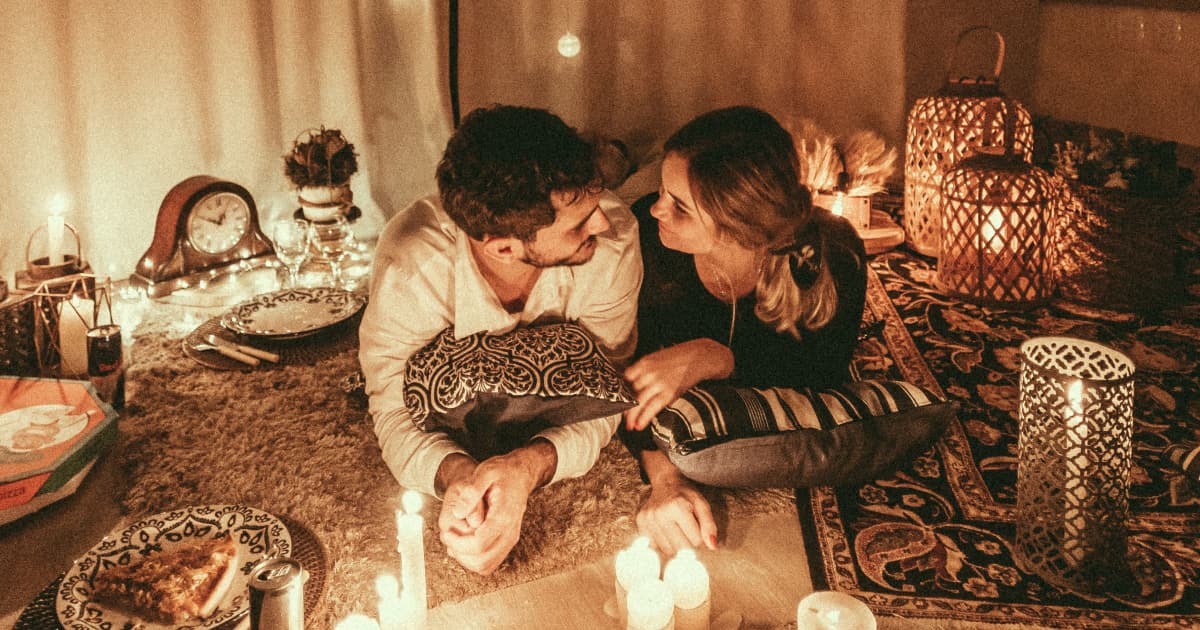
Date night ideas at home that actually feel like a date
A good date night at home isn't Netflix and takeaway with candles. Here are 14 ideas that make staying in feel like a real occasion — not a compromise.

Staying in is only a compromise if you treat it like one.
The problem isn't the location. It's that most couples default to the exact same routine — same sofa, same screen, same takeaway — and then call it a date night because they're in the same room. That's not a date. That's a Tuesday.
The ideas below require your home but not your couch. Some take ten minutes to set up. Some need a bit of planning. None of them feel like settling.
Why date nights at home fail
The usual version: someone suggests staying in, the other agrees (or suggests it first), you order food, open something to watch, and by 9pm you're both half-reading your phones. The evening wasn't bad. It just wasn't a date.
The fix isn't effort — it's structure. The same reason a restaurant date works isn't the food or the ambience. It's that the format makes it obvious this is different from a regular evening. Date nights at home fail when they don't have that signal. The ideas below all have it built in.
Date night ideas at home that cost almost nothing
1. The blind taste test
Pick a theme — wine, hot sauce, chocolate, cheese, budget supermarket pasta sauces — and buy four or five options without showing your partner. Cover the labels. Score each one on taste, texture, value. The competition makes it an event; the tasting makes it a conversation.
Works with takeaway too: order the same dish from three different places, present them unlabelled, pick a winner.
2. Cook something neither of you has made before
Not a complicated recipe. Just something outside your rotation — a cuisine you haven't tried at home, a technique one of you has been curious about, a dish from somewhere you've travelled. Look up one recipe together, agree on it, cook it without splitting off to your phones.
The cooking is the date, not just the preamble to it.
3. The 45-minute documentary rule
Each of you picks a documentary or short film the other knows nothing about. You watch yours first, they watch theirs second. No phones during either. Talk about both after.
The constraint — it has to be something the other person hasn't seen and you haven't mentioned — makes the choice mean something. You're showing each other something you wanted them to see.
4. Teach each other something
One of you picks a skill, knowledge area, or story the other doesn't know about and spends 20 minutes explaining it properly. Then swap. Rules: no PowerPoint, no condescension, no phones. Questions allowed.
It sounds potentially awkward. It tends not to be. Watching someone explain something they actually care about is one of the more underrated forms of intimacy.
5. The letter game
Write your partner a letter. Not a long one — two or three things you haven't said recently, one memory from the last year worth keeping, one thing you're looking forward to. Swap and read them at the same time. Don't discuss immediately. Give it ten minutes first.
Some couples do this annually. It's worth starting.
Date night ideas at home with a bit more setup
6. Home tasting menu
Pick four restaurants you both like — ideally different cuisines. Order one course from each: starter from one, main from another, dessert from a third, drinks or snacks from the fourth. Present each course separately with a five-minute gap between. The pacing changes the whole feel of the evening.
Expensive compared to one takeaway. Cheaper than a restaurant. Feels more like the latter.
7. The mystery challenge night
Write five challenges on separate slips of paper — things you'd dare each other to do at home, questions you've never asked, small bets. Fold them. Take turns pulling one and completing it before you can discuss it.
If you want to skip the setup, BlindfoldDate assigns you a challenge for the night automatically — it's designed for going out, but the challenge mechanic works just as well at home. Try your first one free at blindfolddate.com.
8. The playlist swap
Each of you builds a playlist of ten songs the other doesn't know — things that mean something to you, songs from before you met, things you've been listening to alone. Play them in alternating order, one from each playlist. After each song: why this one?
It's a conversation prompt disguised as a music night.
9. At-home version of somewhere you've been
Pick a place you've travelled together — or somewhere one of you has been. Find a recipe from there, a film set there, or a drink associated with it. Spend the evening in that context. If you have photos from the trip, look at them. If you haven't been there together, make it a place you want to go.
10. The question card game
Not Cards Against Humanity. Something that actually produces a conversation — We're Not Really Strangers, Esther Perel's Where Should We Begin? card game, or just a list of questions you find and read aloud to each other. The format makes asking feel less intrusive than it would cold.
Date night ideas at home for low-energy nights
11. The one-episode rule
Pick a series neither of you has started. Watch one episode only. Discuss it properly — not just "did you like it?" but what you'd do in that situation, whether you trust the premise, whether you'd watch the second. Then decide together whether to continue or switch.
It's a small version of watching something with intention instead of inertia.
12. Order something you've never tried
Open a delivery app. Filter to a cuisine neither of you eats regularly. Order three things from the menu you know nothing about — not the safest option, not the thing that sounds most like something you already like. Eat it at the table, not the sofa.
The novelty is enough to make an ordinary Thursday feel like something else.
13. Do nothing, but do it intentionally
Make a drink. Sit somewhere comfortable. Put on music, not a screen. Talk. The only rule: no phones on the table and no bringing up logistics — work, errands, calendar coordination. Everything that's not about being together in that room can wait an hour.
This is the hardest one for most couples because it has no structure. It's also occasionally the best one.
14. Let the app plan your next one
If tonight is genuinely a low-energy night, use it to plan the next date properly. Open BlindfoldDate, set your preferences, and let it pick somewhere. You won't see the destination until you're on your way — which means by the time next date rolls around, you've already got a plan and neither of you had to make a decision.
Why staying in works when you treat it like going out
A foundational set of experiments by Aron and colleagues found that couples who did something novel and stimulating together, rather than pleasant but familiar, reported higher relationship satisfaction afterward — even when the activity itself was small. The location is almost irrelevant. What matters is whether the evening feels different from the default.
A date night at home can do that. A restaurant can fail to do it. The variable is intentionality, not postcode.
The ideas above all work on the same principle: they introduce a constraint, a format, or a rule that makes the evening structurally different from a regular night in. That signal — that this evening has a shape — is what makes it register as a real occasion. The same trick rescues the most loaded occasion of all — see anniversary date ideas that don't feel like an obligation.
For nights when you want to get out of the house instead, the surprise date night ideas post covers options where neither of you makes the decision. And for evenings when the budget is the main constraint, cheap date ideas under $30 works both in and out.
Frequently asked questions
How do you make a date night at home feel special?
Change something about the format. Eat at the table instead of the sofa. Put phones in another room. Pick an activity that has a clear beginning and end. The goal is a signal that this evening is different — the specific activity matters less than the fact that you've made it distinct from your default.
What's a good date night at home for couples who've been together a long time?
Anything that introduces a small element neither of you could fully predict: the blind taste test, the playlist swap, the question card game, the letter exchange. Long-term couples don't need elaborate — they need different enough to actually pay attention to each other.
How often should couples do date night at home vs going out?
There's no ratio that works universally. What tends to matter is consistency — couples who protect date nights regularly, regardless of format, report higher satisfaction than those who go out occasionally but inconsistently. One well-structured evening at home beats one perfunctory dinner out.
Is it okay if date night at home is just watching TV?
If you're both actually present and engaged, yes. The problem is that TV-as-default tends to be neither — it's a way of being in the same room without actually connecting. If you're going to watch something, use the one-episode rule above and actually discuss it after.
The date night is at home. The decision doesn't have to be.
You still have to decide what to do. That's the part that drains people — not the going out, but the choosing.
BlindfoldDate handles the decision either way — a mystery venue for nights out, or a surprise at-home challenge for nights in. Pick your preferences, find out what's planned on the way. One date per month, free. No card required.
The list above gives you the ideas. BlindfoldDate picks for you when you don't want to.